


A familiar scenario: a company pours money into paid advertising, traffic grows, but sales and inquiries lag behind. The first instinct is usually more budget; the second – a full redesign of the page. Rarely, though, is either move the right one on its own.
The answer to the dilemma “more advertising or a better page” starts somewhere else – by finding where exactly effectiveness is lost: in the campaign itself, in the page that greets the visitor, or in the way you measure the result. Below is a practical framework that connects your advertising numbers with how people behave and with real profit.
More ad budget does not automatically mean more sales
Every paid campaign goes through a chain of steps. The user sees the ad and clicks on it. Once they land on the page, within seconds they judge whether the offer is worth it. From there on, everything depends on whether the page and the offer convince them to take the next step.
Added budget moves only the first link – impressions and clicks. If something further down the chain does not work well, a higher budget simply sends more visitors to the same problem. Traffic has value when:
- It reaches the right audience;
- The page convinces users to take action;
- The business manages to turn inquiries into real sales.
Otherwise, you increase costs without achieving proportionally better results.
How to tell whether the problem is in the advertising or in the landing page?
Diagnosis always precedes treatment. Four typical situations point to where the weak spot lies.
The advertising attracts the wrong traffic
Unsuitable keywords, overly broad targeting or a misleading message bring clicks from people with no real interest in the offer. The visitor lands on the page with different expectations and quickly leaves. Here the first correction is in the campaign setup – the choice of keywords, the audiences, the message – not in the design of the landing page. When advertising does not reach the right audience, even a well-optimized page will struggle to achieve the desired results.
There are visits, but few conversions
Advertising attracts suitable visitors, but only a small share of them take the desired action – a purchase, an inquiry or a registration. The reason may be an unclearly presented offer, a mismatch between the ad message and the content of the page, or the lack of enough arguments to convince the user to trust the business. Even minor obstacles, such as an overly long contact form or an inconvenient mobile version, can turn away potential clients. In such a situation it is important to establish what stops visitors and to remove the specific barriers to conversion before increasing the ad budget.
There are inquiries, but few real clients
A large number of inquiries does not guarantee more sales. If few of them lead to real deals, the reason may lie in the offer itself, in the audience the advertising targets, or in the follow-up handling of inquiries. Slow responses, a lack of follow-up contact, or inquiries from people who do not match the profile of the potential client can hinder good results even with a working ad campaign. Before you increase the budget, check not only how many inquiries you receive, but also how many of them turn into clients.
The data does not give a reliable answer
Before you change the ad budget or the landing page, make sure the data you rely on is correct. Check whether conversion tracking works, whether GA4 records the important actions properly, and whether the advertising platforms receive the necessary data. If you use a CRM, also check whether the information about inquiries and closed deals is passed on correctly.
When tracking is set up incorrectly, you may misjudge the campaign’s effectiveness and invest in changes that do not solve the actual problem. So first verify the reliability of the data, and only then decide what to optimize.
| Observed problem | Likely cause | What to check first |
|---|---|---|
| Many clicks, but few engaged visits | Unsuitable traffic or a mismatch between the ad and the page | Keywords, audiences and the match between the ad message and the page content |
| Visits without conversions | An unconvincing offer or obstacles to action | Page content, calls to action, contact forms / checkout process and mobile version |
| Many inquiries, but few sales | Low inquiry quality or a problem in follow-up handling | Qualification criteria, response time and data on actually closed deals in the CRM |
| Missing or inconsistent data | Incorrect tracking, duplicated events or an integration problem | GA4 event settings, ad tags and pixels |
When does it make sense to increase the ad budget?
Increasing the ad budget is justified when the campaigns already deliver good results, there is potential to attract more suitable clients, and the business can serve them. Three conditions suggest it is time to consider the next step.
The campaigns already deliver results at an acceptable cost
The number of sales on its own is not enough to assess the effectiveness of advertising. What matters is how much it costs you to acquire one client, what revenue they bring and what margin remains after costs. If the campaign attracts clients at a cost that allows good returns, increasing the budget can help achieve higher results.
There is potential for additional relevant traffic
Sometimes campaigns achieve good results, but the available budget limits the number of people the ads can reach. If there is enough demand and additional budget would provide access to more potential clients, an increase may be justified.
Before that, however, check whether it is really the budget that is limiting the results. In Google Ads Search this is visible from the Search lost IS (budget) metric – the share of impressions the campaign misses due to an insufficient budget. If it is low, more money will not bring significantly more traffic. Before you expand the campaign with new keywords, check the real search volume in Keyword Planner and in the search terms report.
Low demand, a narrow audience reach, or an insufficiently convincing offer require a different approach. More money will not solve a problem that stems from the campaign itself or from the offer to clients.
The business can serve more clients
More inquiries and orders are useful only if you can handle and fulfill them on time. Before you increase the budget, assess whether the team has the necessary capacity, whether you have enough stock, and whether your service and delivery processes can handle a larger volume of work.
If new clients wait too long for a response or their orders are not fulfilled on time, a higher ad budget can create more problems instead of improving results. So increase the investment gradually and monitor how costs, sales and service quality change.
A practical rule: increase the budget by no more than 20% at a time and wait 7-10 days before the next step. This gives the advertising platform time to adjust, and you see whether the cost per conversion holds. Google Ads automated recommendations for a higher budget are not on their own a reason to increase it.
When should you invest in a better landing page first?

When advertising reaches the right audience but visitors rarely take the desired action, the problem may be in the landing page. Before you increase the budget, check whether it meets visitors’ expectations, presents the offer convincingly and makes the next step easy.
The ad message and the page do not match
The visitor should find on the page what the advertising promises them. If there is a mismatch between the keyword, the ad message, the offer and the content, they may not find the information they are looking for and leave without taking action. Google Ads accounts for the relevance and usefulness of the landing page relative to the search when forming the diagnostic quality indicator for the ad (Quality Score). The assessment is visible in the ad account itself: in the keyword list, add the Quality Score and Landing page exp. columns. If the page experience is rated as Below average, this is a signal that visitors do not find on it what the advertising promises them.
The benefit to the user is not immediately clear
As soon as the page opens, the visitor should understand what you offer, what benefit they will get, and how they can take advantage of the offer. Review the main heading, the description of the offer, the specific benefits and the call to action. General promises such as “high quality” and “individual approach” are rarely enough on their own. State what sets your offer apart and why it suits the needs of the potential client.
The page creates unnecessary obstacles
Slow loading, an inconvenient mobile version, an overly long checkout process / contact form, and unclear buttons can turn away a visitor even when the offer interests them. Check how easily one reaches a purchase or sends an inquiry, and whether there are steps that unnecessarily complicate the process. Start by removing the problems that directly hinder action, instead of focusing first on cosmetic changes.
There is not enough proof of trust (social proof)
Before making a purchase or sending an inquiry, the visitor needs a reason to trust the business. Real client reviews, concrete examples from practice, clear prices and terms, as well as accessible information about the company help in making an informed decision. Use verifiable proof and avoid unsupported claims. Trust is built with credible information, not with promises you cannot confirm.
Which changes to prioritize?
Order the changes by their expected impact and the effort required. First, remove the technical and functional problems that hinder a purchase or sending an inquiry. Then improve the message, the presentation of the offer and the calls to action. Design and structure also matter, but changes to them should solve a specific problem rather than being based solely on personal preference.
This is also the core principle of conversion rate optimization: to establish what stops visitors, to make targeted improvements, and to measure whether they lead to better results.
Which metrics to track before you decide?
| Metric | What question it answers |
|---|---|
| CTR (click-through rate) | Does advertising attract interest and clicks? |
| CPC (cost per click) | How much does one visit cost? |
| Conversion rate (CVR) | What share of visits leads to the desired action? |
| CPA (cost per conversion) | How much does one recorded conversion cost? |
| ROAS | What revenue does each invested euro bring, and does it cover the margin? |
| Inquiry quality | Do inquiries turn into clients? |
Look at the metrics in combination. A low CPC does not guarantee quality traffic, and a high conversion rate does not necessarily mean good financial results. Compare the data from the advertising platforms with real sales and the quality of inquiries. This way, the analysis of your marketing results will help you establish where the problem is and what you need to optimize.
ROAS shows revenue, not profit. To judge whether a campaign is profitable, compare it with the break-even ROAS, which is calculated as 1 / margin. For example, at a 25% margin a campaign with a ROAS of 4 only covers its costs, without making a profit.
How a higher conversion rate changes the effectiveness of the ad budget
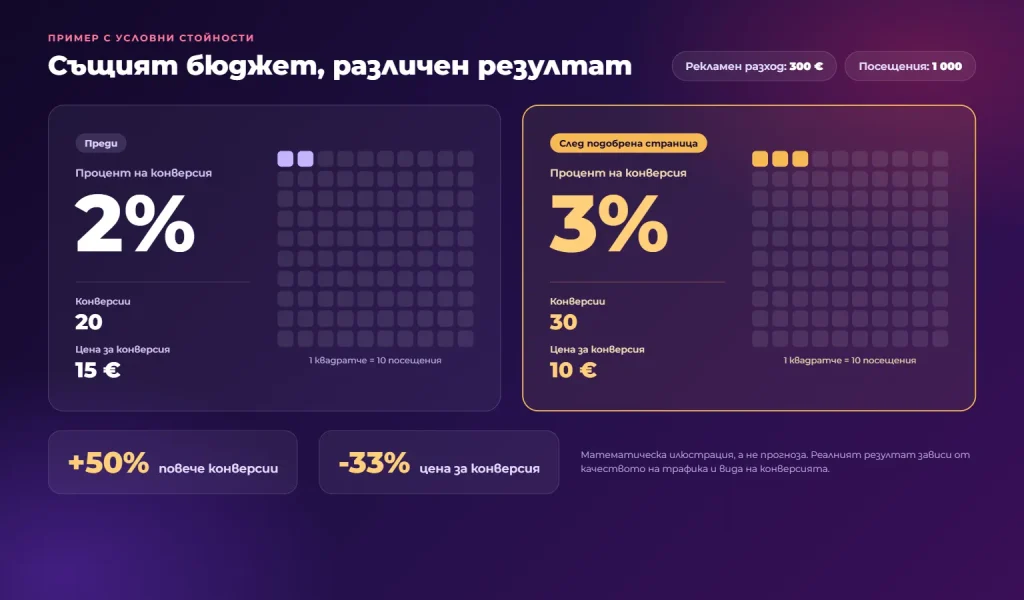
Improving the landing page can increase the number of conversions without the need to attract more visitors. Let’s look at an example with illustrative values:
- At a 2% conversion rate – a thousand visits yield 20 actions.
- At a 3% conversion rate – the same thousand visits yield 30 actions.
That is 50% more conversions for the same number of visits. If ad spend stays unchanged and the conditions are comparable, the average cost per conversion drops by about a third.
It is important to clarify that this is a mathematical illustration, not a forecast for a specific campaign. The real result depends on the quality of the traffic, the type of conversion, and how far the generated actions turn into revenue and profit.
How to determine your next investment – step by step
Step 1. Check whether you are measuring the real results
Make sure you track the actions that matter to the business – purchases, successfully submitted forms and qualified inquiries. A click on a button can be a useful signal for analysis, but it is not the same as a completed conversion. Also check whether the data is recorded correctly.
Step 2. Establish where you are losing potential clients
Trace the path from the ad to the sale. Does the campaign attract suitable visitors? Do they take the desired action? Do inquiries turn into real clients? The answers will help you establish whether the problem is in the targeting, the landing page or the subsequent sales process.
Step 3. Determine which change is the highest priority
Do not change everything at once. Choose the problem whose solution has the greatest potential to improve results, taking into account the required costs, time and resources. This way you will be able to assess the effect of each change more easily.
Step 4. Test the changes and increase the budget gradually
Compare the results before and after the changes under conditions that are as comparable as possible. If the data confirms that the campaign delivers good results and there is potential to attract more suitable clients, increase the budget gradually. Monitor whether the cost per conversion and the quality of acquired clients are maintained.
Conclusion: Do not increase the budget before you establish what is limiting the results
There is no universal answer to the question of whether to invest in more advertising or in a better landing page. If the ads attract suitable visitors but they rarely take the desired action, check the page, the offer and conversion tracking. If the campaigns already deliver good results at an acceptable cost and there is potential to reach more relevant audience, increasing the budget may be the next reasonable step.
What matters is that the decision is based on data, not on assumptions.
At CreateX, we approach advertising through analysis of campaigns, reliable results tracking and conversion optimization. The goal is to establish where there is potential for improvement and how the marketing budget can contribute to achieving business goals. If you are looking for performance marketing services that start with analysis and clear priorities, explore the options for optimizing your advertising with CreateX.